
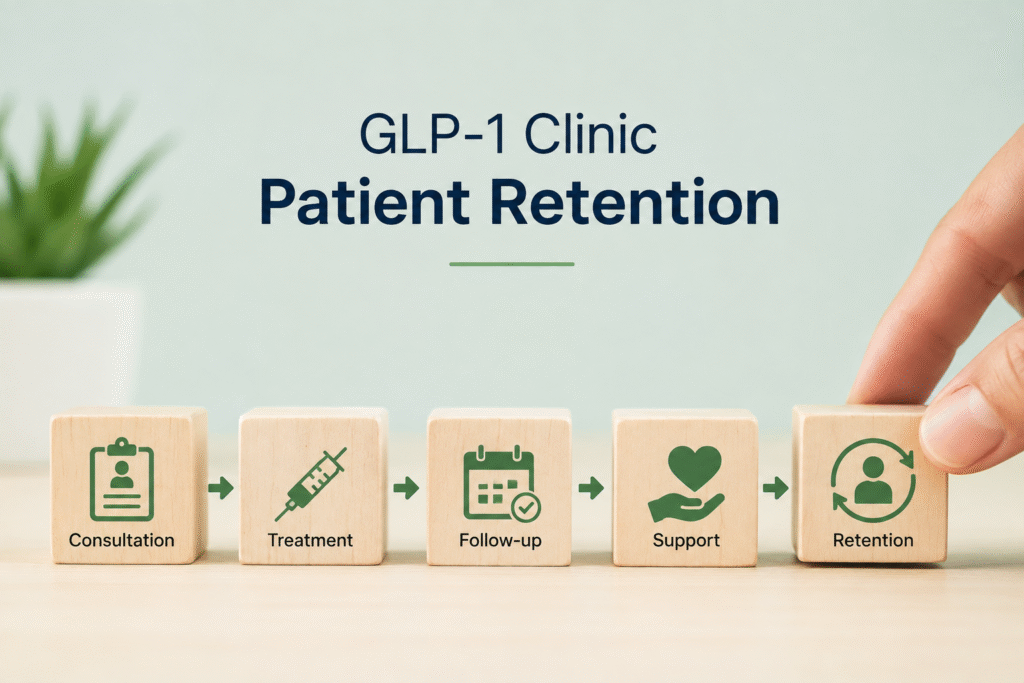
As GLP-1 access becomes easier, medication alone becomes less differentiated. The clinics that win will build trusted, clinically supported patient journeys.
A successful GLP-1 Clinic will do more than provide a prescription. They need to create an organized pathway for their patients’ experiences, including managing side effects, costs (affordability), patients’ expectations, plateau points, and behavioral modifications prior to these concerns becoming reasons for abandonment of services.
While demand may be responsible for scheduling the initial consultation, retention will determine if the Clinic will develop a sustainable business model.
With telehealth being used as a medium for remote prescribing; new Clinics launching campaigns, collecting deposits and beginning to treat patients in just weeks – the GLP-1 Market has given a misleading impression that acquiring patient appointments is relatively simple. However, with weight loss slowing down at approximately three months after initiation of treatment, nausea is still present, the patient’s insurance company is now requiring different procedures for reimbursement, there are ten day periods when the patient doesn’t see a significant movement on the scale – and no one from the Clinic has called since the last refill was ordered – this is typically when a GLP-1 Clinic will find out if they developed a Medical Program or simply a means for patients to obtain Medication.
Patient retention rates for GLP-1 Patients are determined by the number of patients remaining clinically active and receiving consistent treatment over time. This rate is affected by factors such as medication accessibility, management of side effects, how well the patient feels they are progressing, cost (the patient’s ability to afford), communications from the clinic, and overall quality of care provided to the patient.
Why Do So Many GLP-1 Patients Discontinue Treatment?
Patients leave GLP-1 weight loss programs when the burdens of money, time, and/or paperwork become greater than the perceived value that patients receive from their GLP-1 program.
In a 2025 cohort study published in the JAMA Network Open, more than 125,000 adult overweight/obese patients (who had initiated a dual-indicated GLP-1 receptor agonist) were studied. A majority of these patients discontinued therapy within one year. Those without Type II Diabetes, who comprise the largest segment of the medical weight loss market using cash pay models, experienced an even higher rate of discontinuation.
JAMA also discussed the estimated 12-month discontinuation rates for this class of drugs at approximately 50%-75%. Therefore, it’s likely that patients don’t simply “lose interest,” but rather coverage issues, out-of-pocket expenses, side effect experiences, drug shortages, or lack of supportive services create opportunities for them to stop taking their medication.
Therefore, for operators, there is no single reason for patient churn. Rather, it typically occurs due to a series of smaller failures such as:
- the patient doesn’t know what the typical early side effects are associated with the medication.
- messages regarding nausea or constipation go unread/unanswered.
- progress is measured solely by scale weight loss.
- a plateau is viewed as evidence that the medication has failed.
- patients are contacted primarily by the clinic for billing/refill purposes.
- no transition plan, either financially or clinically, is developed if/when the patient’s ability to obtain service changes.
Why Medication Access Is No Longer a Defensible Advantage
Access to Semaglutide and Tirzepatide is becoming a commodity. Clinical Continuity is Not.
In October 2024, the FDA said that the tirzepatide injection shortage was over and the semaglutide injection shortage ended in February 2025. In 2026, the agency began examining telehealth companies for the possible misrepresentation of mass-marketed non-FDA-approved compounded GLP-1 products and began monitoring their advertising.
Economically, these are important. If a clinic’s business model relies on low-cost compounded access to GLP-1 products, it will be susceptible to changes in availability, potential government action against the compounder, and competitive pricing by national telemedicine providers.
On the other hand, if a clinic provides comprehensive long-term obesity treatment, its business model is much less susceptible to such disruptions. The clinic can continue to provide patient-centered care throughout all stages of medication use, including initial choice; dose adjustments; adverse events; dietary needs; changes in body composition; weight loss/weight gain maintenance as well as clinical decision-making regarding discontinuing or changing medications.
What the Stronger GLP-1 Clinics Do Differently
Medical Weight Loss Clinics operate in a very similar way: they are all well-managed during the first month of treatment. The time after the visit until before the next appointment is usually completely unobservable.
Patients receive a thorough consultation with explanations of their medications and a warm reception at the beginning of treatment. Then, the clinic waits for patients to report problems.
This model finds problems. This model does not find “dis-engagement” from treatment.
Resilient clinics have identified that silent periods are also data. Missing a scheduled weigh-in date, missing read messages on education, delayed refills of prescribed medication (for example), side effects that remain unaddressed, and rescheduling follow-ups may be signs of early stages of potential churn. Clinic staff do not need to contact every patient each week; however, there should be some mechanism to determine which patients require personal interaction.
Patient retention increases when communications with patients are initiated based upon the level of risk for those patients, rather than based solely upon the passage of calendar time.
What Does the Current GLP-1 Data Mean for Clinic Economics?
High demand does not automatically produce high lifetime value.
Operating issue | What the evidence shows | Business implication |
Treatment persistence | Real-world discontinuation can reach 50% to 75% within 12 months | Acquisition spending is wasted when early churn is ignored |
Affordability | Half of current or former users surveyed by KFF described GLP-1 drugs as difficult to afford | Payment and coverage conversations must begin before a crisis |
Coverage variation | Only 13 state Medicaid programs covered GLP-1s for obesity under fee-for-service as of January 2026 | Clinics need payer-specific and cash-pay transition workflows |
Switching | A 2026 JAMA Network Open study found switching is a common treatment trajectory | A medication change should not automatically become patient loss |
Sources: JAMA, JAMA Network Open and KFF.
Consider a clinic that spends $300 to obtain a patient and makes an additional $200 in monthly contribution margin for each month that patient stays at the clinic. That means after three months the patient has contributed a total of $600 (three months * $200) prior to fixed overhead. After nine months, the patient’s total contribution is now $1800 (nine months * $200).
These figures were used as examples and do not reflect any actual industry averages. However, increasing six months of proper retention may provide more value than decreasing your acquisition costs by ten percent or fifteen percent.
How Can a GLP-1 Clinic Improve Patient Retention?
Build a care pathway before buying leads for your practice. Define how you will respond to issues your patients may encounter with treatment (ie side effects, missing a scheduled appointment, reaching a plateau in progress, losing health coverage, requesting to discontinue treatment) during the next 6 months.
Here are five things you can start doing this week to create the foundation of that care pathway:
1. Track retention by cohort. Calculate the percentage of patients who remain active at each of the following intervals: 30 days; 90 days; 180 days; and 365 days. Determine if these percentages are separate for each of the following cohorts: insurance-supported patients; branded cash-pay patients; compounded-medication patients.
2. Establish early warning indicators. Identify which of the following events would trigger an alert within your practice: missed appointments; delayed payment; refill delays; low patient engagement; unresolved patient complaints about symptoms.
3. Develop consistent language for plateau communication. Educate your patients before they reach a plateau in treatment about the fact that significant and sustainable weight loss is typically not a straight-line process and therefore that dose escalations are not always the most effective responses to plateaus.
4. Assess more than just weight loss. In addition to tracking weight loss, also Track: waist circumference; strength gains; protein intake; symptoms of adverse reactions; adherence to treatment plans; relevant metabolic markers when clinically indicated.
5. Develop transition pathways. Develop guidelines for when you need to switch medications; when a patient’s insurance coverage is lost; when you need to transition a patient to a maintenance program; and/or when a patient needs to be discontinued from treatment due to direction from a physician.
Key Takeaways
First purchase (of a GLP-1 drug) is often made by people who are new to the product; however, it is long-term patient relationships that create value over a person’s lifetime.
Most of the time that people stop taking their prescribed GLP-1 drugs, they are doing so because they have had side effects, the cost has become too high, they have hit a plateau in weight loss, or there was poor follow-up after the initial consultation.
Just as clinics use the same discipline to track leads and booked consultations, they can also apply this discipline to measuring retention at 30 days, 90 days, 180 days, and 365 days.
The best GLP-1 clinic will likely be the one where a patient feels medically supported during times of difficulty, expense, or decreased enthusiasm for continuing his/her treatment.
BraveLabs helps specific GLP-1 clinics and other healthcare companies develop ways to link patient acquisitions to the intake processes, communication methods, and follow-up procedures that occur once an appointment has been scheduled.
Q1: Why do patients stop using their GLP-1 medications?
There are several reasons why patients will stop using these medications, as they may have issues with cost, insurance, or some type of gastrointestinal side effect, medication availability, progress does not meet their expectations, or there is no adequate follow-up. The majority of the time, it is a combination of multiple barriers at once that causes discontinuation of use.
Q2: How long do patients use GLP-1 medications?
Depending upon the amount of coverage available for the patient, and their tolerance level for this class of medications, along with their personal preferences, treatment length varies. Research conducted outside of clinical trials has shown that many times patients stop using these medications due to lack of satisfaction and/or effectiveness (i.e., most people who suffer from obesity require ongoing treatment).
Q3: How can a Medical Weight Loss Clinic improve its patient retention rate when prescribing GLP-1 medications?
To retain GLP-1 patients, clinics should monitor patients’ engagement in the program from day one and respond promptly to adverse reactions experienced by the patient. Patients also need to have realistic expectations about what is possible through the weight loss program. Clinics also need to assess patients’ outcomes over time, including all aspects related to body mass index (BMI) such as waist circumference, percent body fat, and blood pressure readings. In addition, clinics need to provide patients with an understanding of the process required for changing coverage, replacing medications, and maintaining treatment.
Q4: Is it necessary for a GLP-1 clinic to track patient retention separately from patient acquisition?
Yes. Patient acquisition measures a clinic’s ability to create new patients. Patient retention measures how long patients continue to engage in the weight loss program. Even though a clinic may be able to produce large numbers of leads, if patients stop coming back after just a few months, then the clinic will not make money.
Q5: What would you say is the single largest competitive advantage for a GLP-1 clinic in 2026?
I believe the largest competitive advantage for a GLP-1 clinic in 2026 is establishing a consistent system of care for patients between prescription fill-ups and visits. While other factors like access to affordable medications and pricing can be replicated by competitors, replicating the consistency of care provided to each patient between prescription fill-ups and office visits cannot be easily duplicated.